



RNASE L
RNASEL encodes RNase L, an interferon-inducible endoribonuclease that functions as a central effector of the 2′-5′-oligoadenylate synthetase (OAS)-RNase L pathway, a conserved arm of innate antiviral immunity[1][2]. Upon recognition of viral double-stranded RNA, OAS enzymes synthesize 2′-5′-linked oligoadenylates (2-5A), which bind and activate RNase L, leading to the cleavage of cellular and viral RNA and suppression of viral replication[1][3][4]. Mechanistically, RNase L-mediated RNA fragmentation not only restricts pathogen replication but also promotes downstream stress and immune signaling, including activation of ZAKα-dependent ribotoxic stress pathways and antiviral transcriptional programs[2]. Beyond classical antiviral defense, the OAS-RNase L axis regulates inflammatory responses, and genetic defects in this pathway have been linked to severe inflammatory manifestations associated with SARS-CoV-2 infection, highlighting its importance in immune homeostasis[5]. Disease-relevant studies further demonstrate that RNase L participates in tissue-specific biological processes, including the regulation of wound-induced hair follicle neogenesis and epithelial regeneration through modulation of innate immune signaling pathways[6]. Compared with related OAS family members that function primarily as upstream sensors and 2-5A synthetases, RNase L serves as the terminal catalytic effector that directly executes RNA degradation after pathway activation[1][3]. For experimental applications, pharmacological inhibition of RNase L has been achieved using small-molecule inhibitors that block RNase L activity and prevent excessive RNA cleavage, providing useful tools for mechanistic studies of innate immunity, inflammation, and RNA biology[7].
References:
- [1]. Karasik A, et al. The Unusual Role of Ribonuclease L in Innate Immunity. Wiley Interdiscip Rev RNA. 2024 Nov-Dec;15(6):e1878. [Content Brief]
- [2]. Karasik A, et al. Endonucleolytic RNA cleavage drives changes in gene expression during the innate immune response. Cell Rep. 2024 Jun 25;43(6):114287. [Content Brief]
- [3]. Soveg FW, et al. Endomembrane targeting of human OAS1 p46 augments antiviral activity. Elife. 2021 Aug 3;10:e71047. [Content Brief]
- [4]. Ezelle HJ, et al. The Roles of RNase-L in Antimicrobial Immunity and the Cytoskeleton-Associated Innate Response. Int J Mol Sci. 2016 Jan 8;17(1):74. [Content Brief]
- [5]. Lee D, et al. Inborn errors of OAS-RNase L in SARS-CoV-2-related multisystem inflammatory syndrome in children. Science. 2023 Feb 10;379(6632):eabo3627. [Content Brief]
- [6]. Kirby CS, et al. RNase L represses hair follicle regeneration through altered innate immune signaling. J Clin Invest. 2025 Feb 4;135(6):e172595. [Content Brief]
- [7]. Daou S, et al. A phenolic small molecule inhibitor of RNase L prevents cell death from ADAR1 deficiency. Proc Natl Acad Sci U S A. 2020 Oct 6;117(40):24802-24812. [Content Brief]
All Product Categories
-
RNASE L Related Products (15)
Related Products (15)

- 1

-
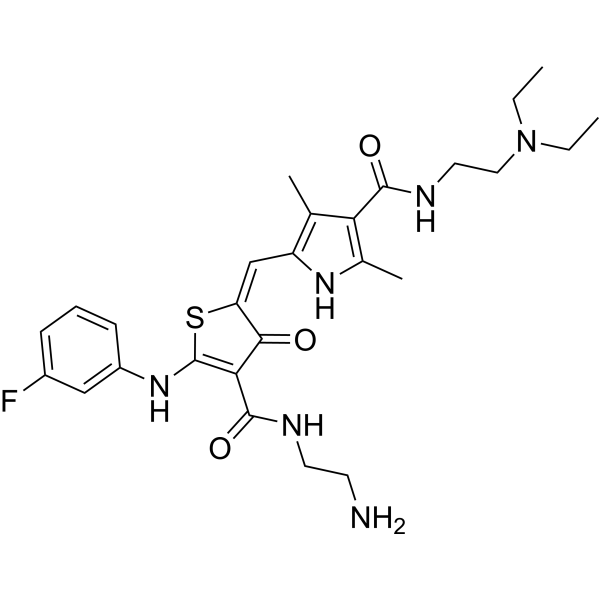
RNase L-IN-1 (trihydrochloride)
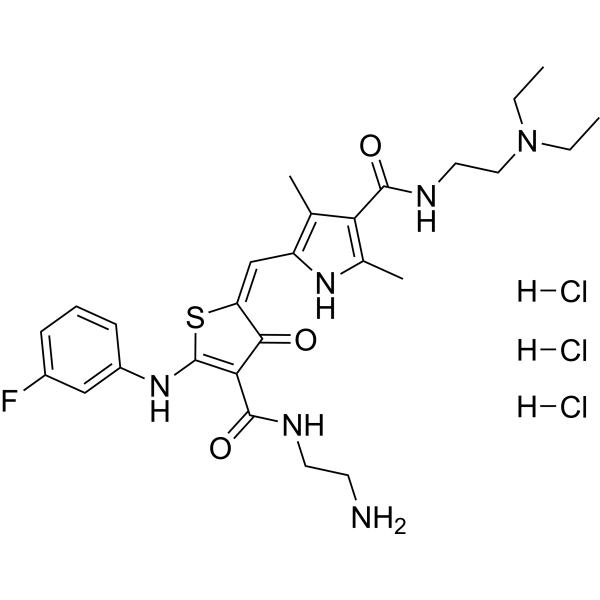 0 ImagesCat. No.: HY-155583APurity: 98.86%
-
2-5A TEA solution (100 mM)
 0 ImagesCat. No.: HY-173189BCAS No.: 72351-33-8Synonyms: 2′,5′-ApApA TEA; 2′,5′-trioligoadenylate TEA; 5'-O-Triphosphoryladenylyl-(2'→5')-adenylyl-(2'→5')-adenosine TEA2-5A TEA (2′,5′-ApApA TEA) is a 5'-triphosphorylated (2',5') oligoadenylate. When covalently linked to an antisense molecule complementary to the target sequence, 2-5A TEA activates RNase L, which subsequently degrades the target RNA bound to the 2-5A TEA chimera. 2-5A TEA can be used in research related to respiratory syncytial virus infection, colorectal adenocarcinoma and melanoma.
-
2-5A pentasodium solution (100 mM)
 0 ImagesCat. No.: HY-173189ASynonyms: 2′,5′-ApApA pentasodium; 2′,5′-trioligoadenylate pentasodium; 5'-O-Triphosphoryladenylyl-(2'→5')-adenylyl-(2'→5')-adenosine pentasodium2-5A pentasodium solution (100 mM) (2′,5′-ApApA pentasodium solution (100 mM)) is a 5'-triphosphorylated (2',5') oligoadenylate. When covalently linked to an antisense molecule complementary to the target sequence, 2-5A pentasodium solution (100 mM) activates RNase L, which subsequently degrades the target RNA bound to the 2-5A pentasodium solution (100 mM) chimera. 2-5A pentasodium solution (100 mM) can be used in research related to respiratory syncytial virus infection, colorectal adenocarcinoma and melanoma.
-
F1-RIBOTAC
 0 ImagesCat. No.: HY-171148CAS No.: 3019907-96-8
-
RNase L ligand 2
 0 ImagesCat. No.: HY-168457CAS No.: 3025538-34-2RNase L ligand 2 (compound 6) is the Rnase L ligand part of RNAse L RIBOTAC (HY-168455), an RNA-degrading chimera which binds to a four-way RNA helix called SL5 in the 5’ UTR of the SARS-CoV-2 RNA genome and inhibits the virus replication in lung epithelial carcinoma cells. RNase L ligand 2 can be used in the synthesis of RIBOTAC.
-
2-5A
 0 ImagesCat. No.: HY-173189CAS No.: 65954-93-0Synonyms: 2′,5′-ApApA; 2′,5′-trioligoadenylate; 5'-O-Triphosphoryladenylyl-(2'→5')-adenylyl-(2'→5')-adenosine2-5A (2′,5′-ApApA) is a 5'-triphosphorylated (2',5') oligoadenylate. When covalently linked to an antisense molecule complementary to the target sequence, 2-5A activates RNase L, which subsequently degrades the target RNA bound to the 2-5A chimera. 2-5A can be used in research related to respiratory syncytial virus infection, colorectal adenocarcinoma and melanoma.

-
RNase L ligand 3
 0 ImagesCat. No.: HY-177030CAS No.: 3036649-51-8RNase L ligand 3 is a RNase L ligand. RNase L ligand 3 can be used for synthesis of F3-PEG8-RiboTAC (HY-176259).
-
NCI-65828 sodium
 0 ImagesNCI-65828 (N-65828) sodium is a cell-permeable small molecule inhibitor. NCI-65828 inhibits the ribonuclease activity of human angiogenin and zebrafish Rnasel-1/3, as well as the activity of Mycobacterium tuberculosis AccD5 and its holoenzyme complex. NCI-65828 induces neuronal developmental defects, impairs vascular development, inhibits neurite outgrowth, and reduces protein synthesis in stem cells and neural progenitor cells, but shows no significant growth inhibitory effect on various human tumor cell lines. NCI-65828 is primarily used to study the role of angiogenin-like ribonucleases in neural and vascular development, to establish effect models of ALS-related angiogenin mutants, and in research related to amyotrophic lateral sclerosis, frontotemporal dementia, and tuberculosis.
-
RNAse L RIBOTAC
 0 ImagesCat. No.: HY-168455RNAse L RIBOTAC (compound C64) is an RNA-degrading chimera which binds to a four-way RNA helix called SL5 in the 5’ UTR of the SARS-CoV-2 RNA genome and inhibits the virus replication in lung epithelial carcinoma cells. (Blue: RNA ligand (HY-168456); Black: linker (HY-130591); Pink: Rnase L ligand (HY-168457))
-
RNA recruiter-linker 1
 0 ImagesCat. No.: HY-168458RNA recruiter-linker 1 is the RNA ligand-linker part of RNAse L RIBOTAC (HY-168455), an RNA-degrading chimera which binds to a four-way RNA helix called SL5 in the 5’ UTR of the SARS-CoV-2 RNA genome and inhibits the virus replication in lung epithelial carcinoma cells. RNA recruiter-linker 1 can be utilized in the synthesis of RIBOTAC.
-
GS-646089
 0 ImagesCat. No.: HY-185215CAS No.: 1770840-57-7GS-646089 is a broad-spectrum antiviral nucleoside analog that exhibits significant inhibitory activity against respiratory syncytial virus (RSV), human metapneumovirus (hMPV), rhinovirus (enterovirus) and enteroviruses. The IC50 of GS-646089 targeting RNA-dependent RNA polymerase (RdRp) ranges from 43 to 46 nM. GS-646089 blocks viral replication by being converted into a triphosphate metabolite intracellularly, which competes with ATP for incorporation into nascent RNA strands and acts as an immediate chain terminator. GS-646089 is the parent compound of the double prodrug GS-7682 (HY-161877), and is used in studies of acute respiratory viral infections and infections caused by related pathogens.
-
RNA recruiter 1
 0 ImagesCat. No.: HY-168456RNA recruiter 1 is the RNA ligand of RNAse L RIBOTAC (HY-168456), an RNA-degrading chimera which binds to a four-way RNA helix called SL5 in the 5’ UTR of the SARS-CoV-2 RNA genome and inhibits the virus replication in lung epithelial carcinoma cells. RNA recruiter 1 can be utilized in the synthesis of RIBOTAC.
- 1



